 |
|
| |
| |||
|
|
| |
 |
Classifieds: Cars |  |
| Jobs |  |
| Personals |  |
| USA TODAY |  |

| |||||||||||||||||||||||||||||||||||||||||||||||||||||||||||||||||||||||||||||||||||||||||||||||||||||||||||||||||||||||||||||||||||||||||||||||||||||||||||||||||||||||||||||||||||||||||||||||||||||||||||||||||||

| |||||||||||||||||||||||||||||||||||||||||||||||||||||||||||||||||||||||||||||||||||||||||||||||||||||||||||||||||||||||||||||||||||||||||||||||||||||||||||||||||||||||||||||||||||||||||||||||||||||||||||||||||||
From staff and wire reports
COLOMBO, Sri Lanka — The most powerful
earthquake in 40 years hit early Sunday near the Indonesian island
of Sumatra, sending 20-foot waves crashing onto the densely
populated shores of several Asian nations. The death toll is just
under 20,000 people.
The 9.0-magnitude earthquake was centered 155 miles south-southeast of Banda Aceh, the capital of Aceh province on Sumatra, and 6 miles under the seabed of the Indian Ocean. Geophysicist Julie Martinez of the U.S. Geological Survey (USGS) said it was the fifth-largest quake since 1900 and the largest since a 9.2 earthquake hit Alaska's Prince William Sound in 1964. The initial shock waves destroyed bridges, toppled power poles and severed the trans-Sumatran highway in many places. The domes of several mosques and sections of the largest hotel in Banda Aceh collapsed. Moments later, the first waves hit Aceh and other parts of Indonesia.
Traveling at nearly jetliner speeds, huge waves began pummeling southern Thailand an hour after the quake. In 2 1/2 hours, the walls of water had traveled 1,000 miles to India and Sri Lanka. Neither is part of an international warning system designed to advise coastal communities that a tsunami is approaching. The waves eventually struck Somalia in East Africa. Home to hundreds of active volcanoes, the Indonesian archipelago is at the southern end of one of the world's most seismically active regions, the so-called Ring of Fire that includes Alaska. The quake occurred at a place where geological plates push against each other. The USGS said a 620-mile section shifted, which triggered the displacement of a huge volume of water. President Bush expressed his condolences. "The United States stands ready to offer all appropriate assistance to those nations most affected," he said in a statement issued on Air Force One. He was en route from Washington to his Texas ranch. Pope John Paul II called on the international community to provide assistance. Signs of the carnage were everywhere. Dozens of bodies still clad in swimming trunks lined beaches in Thailand. Villagers in Indonesia picked through their destroyed homes amid the smell of rotting corpses. Rescuers elsewhere found victims wedged in trees and littering beaches. Some 25,000 soldiers and 10 air force helicopters searched for victims in Sri Lanka, where more than a million people were driven from their homes. Another million people were reported homeless in Indonesia.
Thai warships steamed toward outlying islands to rescue survivors, while the Indian air force used helicopters to rush food and medicine to stricken seashore areas. At Thailand's beach resorts, packed with Europeans fleeing the winter cold at the peak of the holiday season, families and friends had tearful reunions Monday after a day of fear that their loved ones had been swept away. Katri Seppanen, 27, of Helsinki, Finland, walked around barefoot, in her salt water-stained T-shirt and skirt, at the Patong Hospital waiting room where she spent the night with her mother and sister. She had a bandaged cut on her leg. "The water went back, back, back, so far away, and everyone wondered what it was — a full moon or what? Then we saw the wave come, and we ran," said a tearful Seppanen, who was on the popular Patong beach with her family. The wave washed over their heads and separated them. Fifty-eight half-naked and swimming suit-clad corpses lay in rows outside the Patong Hospital emergency room. Three babies under the age of one were among the victims. A photo of one baby was posted on the wall of victims, the little corpse in a nearby refrigerator. Thai authorities said 35 of the victims have been identified as foreigners, but the number of Western and Asian tourists who perished in Thailand is expected to be far higher, while another 40 foreign tourists were reported killed in Sri Lanka, including some from Japan. At least three Americans were among the dead — two in Sri Lanka and one in Thailand, according to State Department spokesman Noel Clay. He said a number of other Americans were injured, but he had no details.
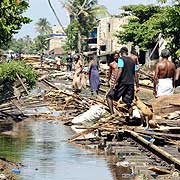
"We're working on ways to help. The United States will be very responsive," Clay said. John Krueger, 34, of Winter Park, Colo., described being inside his bungalow Sunday on Khao Luk Beach, north of Phuket, with his wife when the water filled it and blew it apart. "The water rushed under the bungalow, brought our floor up and raised us to the ceiling. The water blew out our doors, our windows and the back concrete wall. My wife was swept away with the wall, and I had to bust my way through the roof," Krueger said while waiting to talk to a U.S. Embassy official at Phuket City Hall. "It was like being in a washing machine." The earthquake hit at 6:58 a.m. Sri Lanka time; the tsunami came 2{ hours later, without warning, on a morning of crystal blue skies. Sunbathers and snorkelers, cars and cottages, fishing boats and even a lighthouse were swept away. "It's an extraordinary calamity of such colossal proportions that the damage has been unprecedented," said Chief Minister Jayaram Jayalalithaa of India's Tamil Nadu, a southern state which reported 1,705 dead, many of them strewn along beaches, virtual open-air mortuaries. "It all seems to have happened in the space of 20 minutes. A massive tidal wave of extreme ferocity ... smashed everything in sight to smithereens," she said. The quake was centered 155 miles south-southeast of Banda Aceh, the capital of Indonesia's Aceh province on Sumatra, and six miles under the Indian Ocean's seabed, and was followed Sunday by at least a half-dozen powerful aftershocks, ranging in magnitude from almost 6 to 7.3. One aftershock Monday rattled India's Andaman and Nicobar Islands. At least 4,491 were killed in Indonesia. An Associated Press reporter in Aceh province saw bodies stuck in trees and others littering beaches. Dozens of bloated bodies littered the streets of the provincial capital of Banda Aceh, while on city outskirts some 500 bodies lay under plastic tents, rotting in the tropical heat. Victims, many of whom had spent the night sleeping outside on open ground, complained that little or no aid had reached them by Monday. In the provincial town of Lhokseumawe, Dr. Tambah Taibsyah said the hospital treating some 100 seriously injured patients was close to running out of medicine. In Sri Lanka, where a total of 6,517 people were reported killed, extensive damage will complicate efforts to rescue survivors or deliver aid, the country's ambassador to the United States said. "It's going to take time to figure out access to these areas that have been impacted," Devinda R. Subasinghe said Monday in an interview on CNN. The waves' fearsome power was evident in the fishing community of Trincomalee, 140 miles northeast of the capital Colombo, where they tossed boats up to 300 yards inland, spearing some into buildings.
There was reports of sporadic looting in the towns of Galle and Matara in Sri Lanka, and authorities said about 200 inmates escaped from a prison, taking advantage of the chaos. In India, independent reports put the death toll along the southern coast far higher than the officially confirmed total of about 2,300. Press Trust of India news agency put the the overall death toll in India as high as 4,000. At least 600 people died in Thailand, 48 in Malaysia, and 32 in the Maldives, a string of coral islands off the southwestern coast of India. A collapsing bridge killed 12 people in Myanmar. At least two died in Bangladesh — children who drowned as a boat with about 15 tourists capsized in high waves. In India's Andhra Pradesh state, at least 32 Hindu devotees were drowned when they went into the sea for a religious ceremony to mark the full moon. Among them were 15 children. On Monday, bodies of women and children lay strewn on the sand. "I was shocked to see innumerable fishing boats flying on the shoulder of the waves, going back and forth into the sea, as if made of paper," said P. Ramanamurthy, 40, of that state. In the hard-hit town of Cuddalore, survivors huddled Monday in a marriage hall turned makeshift shelter, as fire engine sirens whined outside. Broken boats law on the shore near smashed huts with only frail bamboo frames jutting out of the ground. The earthquake that caused the tsunami was the largest since a 9.2 temblor hit Prince William Sound in Alaska in 1964, according to geophysicist Julie Martinez of the U.S. Geological Survey. "All the planet is vibrating" from the quake, said Enzo Boschi, the head of Italy's National Geophysics Institute. Speaking on SKY TG24 TV, Boschi said the quake even disturbed the Earth's rotation. The quake occurred at a place where several huge geological plates push against each other with massive force. The survey said a 620-mile section along the boundary of the plates shifted, motion that triggered the sudden displacement of a huge volume of water. Scientists said the death toll might have been reduced if India and Sri Lanka had been part of an international warning system designed to advise coastal communities that a potentially killer wave was approaching. Although Thailand is part of the system, the west coast of its southern peninsula does not have the system's wave sensors mounted on ocean buoys. As it was, there was no warning. Gemunu Amarasinghe, an AP photographer in Sri Lanka, said he saw young boys rushing to catch fish that had been scattered on the beach by the first wave. "But soon afterward, the devastating second series of waves came," he said. He climbed onto the roof of his car, but "In a few minutes my jeep was under water. The roof collapsed. "I joined masses of people in escaping to high land. Some carried their dead and injured loved ones. Some of the dead were eventually placed at roadside, and covered with sarongs. Others walked past dazed, asking if anyone had seen their family members." Michael Dobbs, a reporter for The Washington Post, was swimming around a tiny island off a Sri Lankan beach at about 9:15 a.m. when his brother called out that something strange was happening with the sea. Then, within minutes, "the beach and the area behind it had become an inland sea, rushing over the road and pouring into the flimsy houses on the other side. The speed with which it all happened seemed like a scene from the Bible — a natural phenomenon unlike anything I had experienced before," he wrote on the Post's Web site. Dobbs weathered the wave, but then found himself struggling to keep from being swept away when the floodwaters receded. Contributing: Special correspondent Paul Dillon | |||||||||||||||||||||||||||||||||||||||||||||||||||||||||||||||||||||||||||||||||||||||||||||||||||||||||||||||||||||||||||||||||||||||||||||||||||||||||||||||||||||||||||||||||||||||||||||||||||||||||||||||||||



.gif)
.gif) Shortly before 8 p.m. Eastern Standard
Time on Christmas night, 6:58:50 a.m. local time
on Sunday, Dec. 26, an 8.9-magnitude earthquake
took place off the west coast of Sumatra in
Indonesia.
Shortly before 8 p.m. Eastern Standard
Time on Christmas night, 6:58:50 a.m. local time
on Sunday, Dec. 26, an 8.9-magnitude earthquake
took place off the west coast of Sumatra in
Indonesia.
.gif)